While working on ideas that could help build the future of the Last Generation ecosystem, we often come across things that simply don’t work as well as they could.
Sometimes the solution requires a large project, significant investment and years of development.
But sometimes a small change, a simple idea or a different approach can make a surprisingly large difference.
Not every good idea needs to become a Smart Village or a major infrastructure project.
Some ideas are small, practical and easy to understand, yet they have the potential to improve communities, support local businesses, help the environment or simply make everyday life a little better.
Here are a few ideas.
JarCycle
Every year, millions of perfectly usable glass jars end up in recycling containers.
While recycling is certainly better than landfill, the process still requires transportation, crushing, melting and manufacturing entirely new jars. All of this consumes significant amounts of energy.
At the same time, many local producers of pickles, jams, honey and other products purchase brand-new jars even though suitable used jars already exist nearby.
The Glasshouse Project explores a simple idea:
What if reusable glass jars could be traded locally instead of being melted down?
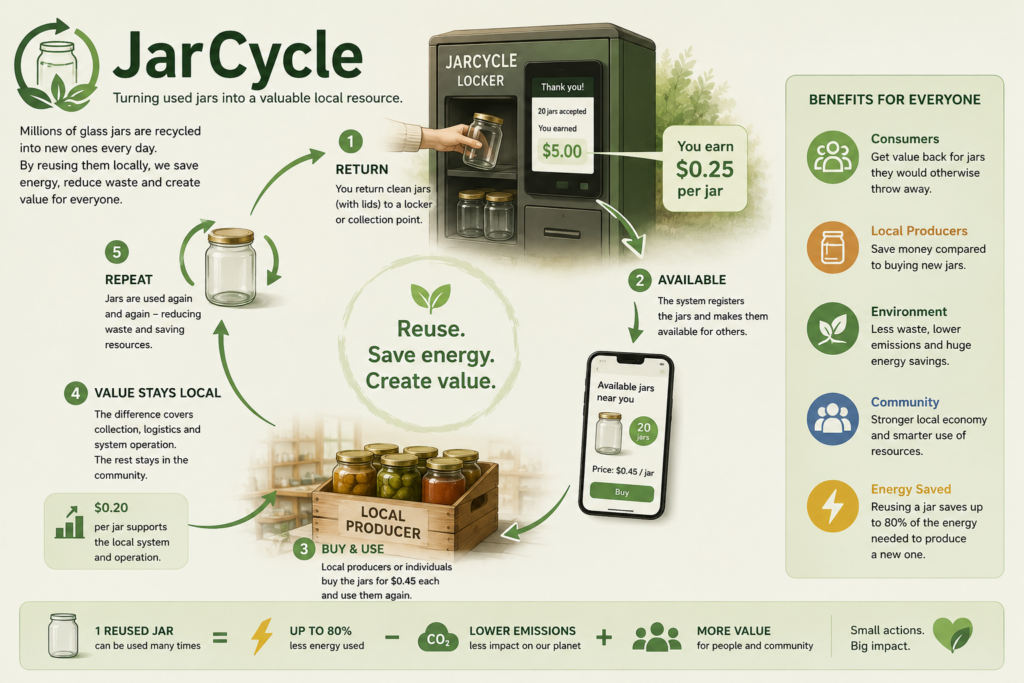
A person could bring clean jars with lids to a collection point, such as a parcel locker or local collection station.
For example:
- A returned jar could earn its owner $0.25.
- The same jar could then be offered to local producers for $0.45.
- The difference would cover collection, logistics and system operation.
The result is a win for everyone involved:
- Consumers receive value for jars they would otherwise throw away.
- Local producers save money compared to buying new jars.
- Communities reduce waste.
- Significant amounts of energy can be saved by reusing instead of remanufacturing.
A simple glass jar may seem insignificant, but multiplied by thousands or millions of units, small improvements can create a meaningful impact.
Sometimes sustainability is not about inventing new technology.
Sometimes it is simply about using existing resources more intelligently.